
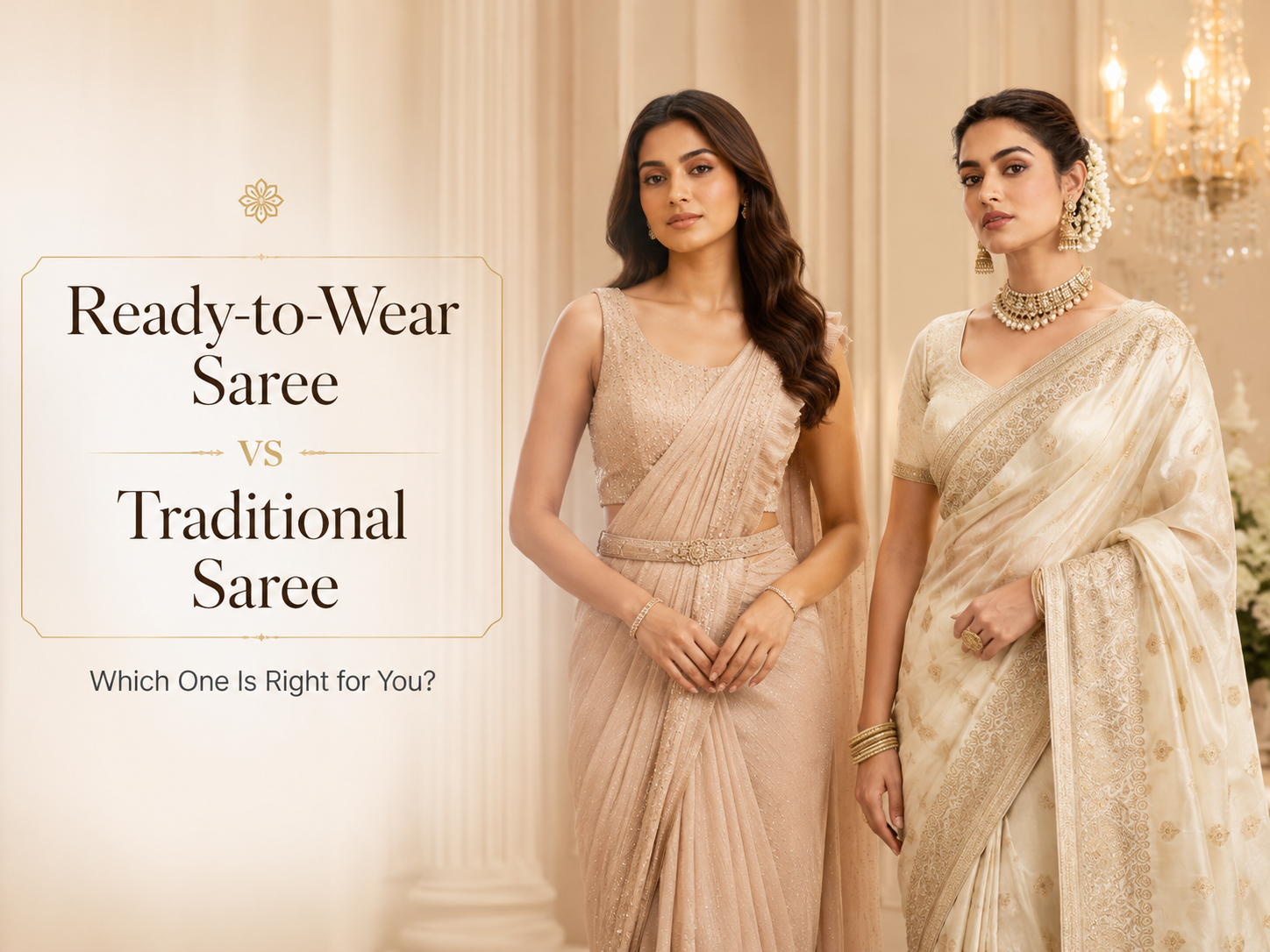
Ready-to-Wear Saree vs Traditional Saree: Which One Is Right for You?
Choosing between a ready-to-wear saree and a traditional saree is less about which one is “better” and more about how you plan to wear it. One prioritizes speed, consistency and convenience; the other gives you maximum control over draping, pleats and styling.
If you shop for Indian outfits online—especially for weddings, festivals, receptions, office events or celebrations abroad—the difference matters. Your available getting-ready time, confidence with draping, travel plans, preferred silhouette and event type can all change which format makes more sense.
This guide breaks down the differences so you can choose the saree format that fits your lifestyle instead of simply following a trend.

What Is a Ready-to-Wear Saree?
A ready-to-wear saree generally refers to a saree that has been pre-stitched, pre-pleated or constructed so that much of the traditional draping work is already done. Depending on the design, you may step into it like a skirt, fasten it at the waist and arrange the pallu rather than building every pleat from scratch.
This format is popular with shoppers who want the visual elegance of a saree but prefer a faster and more repeatable dressing process. It can also be practical when you are attending an event away from home and do not have someone available to help with draping.
You can explore Qivii’s Women’s Ready-to-Wear collection for convenient occasionwear options.
What Is a Traditional Saree?
A traditional saree is an unstitched length of fabric that you drape around the body, create pleats with, tuck at the waist and arrange according to your preferred style. The exact draping method can vary by region, fabric, occasion and personal preference.
The biggest advantage is flexibility. You can adjust where the pleats fall, how tightly the saree sits, how long the pallu appears and how the overall silhouette works with your blouse and footwear. The trade-off is that traditional draping usually requires more time and practice.
For a broad selection of fabrics and embellished styles, browse Qivii’s Designer Saree collection.
Ready-to-Wear Saree vs Traditional Saree: Quick Comparison
| Factor | Ready-to-Wear Saree | Traditional Saree |
|---|---|---|
| Dressing time | Usually faster | Usually takes more time |
| Draping skill | Minimal to moderate | Helpful to know basic draping |
| Fit consistency | More repeatable once sized correctly | Can be adjusted each time |
| Styling flexibility | Depends on construction | Very high |
| Travel convenience | Often easier for quick dressing | May need extra preparation |
| Traditional drape options | More limited | Excellent |
| Best for | Convenience, quick events, beginners | Customization, traditional styling, drape lovers |
1. Which Is More Comfortable?
Comfort depends on three things: fit, fabric and how securely the saree sits during movement. A well-fitted ready-to-wear saree can feel very secure because the main pleats and waist placement are already structured. That can be useful for long events where you want fewer adjustments.
A traditional saree can be equally comfortable—and sometimes more comfortable—when you know how to drape it for your body. You control the tightness, pleat width, pallu length and placement. This flexibility is valuable if you have a specific way you prefer your saree to sit.
The key is not to assume that “pre-stitched” automatically means comfortable or that “traditional” automatically means difficult. Always check the product’s sizing, closure, waist construction and fabric details.

2. Which One Is Faster to Wear?
This is where ready-to-wear sarees usually have the clearest advantage. If the pleats and basic silhouette are already constructed, getting dressed can become a much shorter process. You still need to style the blouse, jewellery, footwear and pallu, but the most technical part of draping may be reduced.
A traditional saree takes longer because you need to build the drape each time. Experienced saree wearers can do this quickly, but beginners often need more time for pleat alignment, pinning and readjustments.
If you regularly attend events after work, travel for weddings, get ready without assistance or simply dislike last-minute draping stress, the convenience of ready-to-wear construction can be a major benefit.

3. Which Gives You More Styling Freedom?
Traditional sarees win when your priority is maximum styling control. The same saree can be draped with a shorter or longer pallu, adjusted for different heel heights, styled more tightly or loosely and adapted to different regional draping traditions.
Ready-to-wear sarees can still be styled in multiple ways through the blouse, belt, jewellery, footwear, hairstyle and pallu treatment, but the core pleat construction is usually more fixed.
If you enjoy experimenting with how the fabric sits on your body, traditional may suit you better. If you prefer a consistent silhouette every time, ready-to-wear can make life easier.
4. Which Is Better for Beginners?
For someone who loves the look of sarees but has never learned to drape one confidently, a ready-to-wear saree can remove a major barrier. It lets you focus on styling and enjoying the event rather than repeatedly checking whether the front pleats are opening or the pallu is slipping.
That does not mean beginners should avoid traditional sarees. Learning a basic drape is useful and gives you far more wardrobe flexibility over time. But if you have an upcoming event and want a lower-stress option now, ready-to-wear is often the simpler starting point.
5. Which Is Better for Weddings and Receptions?
Both can work beautifully. The better choice depends on your role at the event and how formal or active the occasion will be.
- Wedding guest: either format works; prioritize fabric, embellishment and comfort.
- Reception: ready-to-wear can be convenient if you want a polished silhouette with less preparation.
- Close-family wedding functions: traditional sarees offer more styling flexibility when you want a specific drape or heirloom-inspired look.
- Destination wedding: ready-to-wear can simplify getting ready in a hotel or unfamiliar venue.
If you are shopping for a more elevated look, explore Qivii’s Luxe Saree collection.
6. Which Is Better for Parties, Festivals and Work Events?
Ready-to-wear sarees are useful for occasions where speed and movement matter: office celebrations, dinner parties, festive gatherings and events where you need to get ready quickly. Traditional sarees are excellent when you have enough time to create a deliberate drape and want a classic appearance.
For a lighter party look, fabrics such as organza can create a modern silhouette. For example, you can view Qivii’s Teal Blue Floral Print Organza Saree or Orange Floral Print Organza Saree as styling inspiration.

7. What About Fit and Body Shape?
Neither saree type is universally better for a particular body shape. What matters more is proportion, fabric fall, blouse fit, pleat volume and where the waistline sits.
Ready-to-wear sarees depend more heavily on choosing the correct size because some of the silhouette is already constructed. Check the product measurements carefully before ordering. Traditional sarees give you more freedom to control pleat volume and waist placement during draping.
If you are between sizes or ordering for a specific function date, review the garment measurements instead of relying only on your usual letter size.
8. Which One Travels Better?
For many travelers, ready-to-wear wins on convenience. You can arrive at a destination, steam the outfit if needed, put it on and spend more time on jewellery, makeup or hair instead of building a drape from the beginning.
Traditional sarees are still excellent travel pieces because the fabric itself packs relatively flat, but you may need pins, a suitable petticoat or underskirt, and enough time to drape properly. If you know your drape well, this may not be a disadvantage at all.
9. How Should You Accessorize Each Style?
Use the saree’s visual weight as your guide. A heavily embellished saree usually needs fewer competing accessories, while a simpler saree can handle a stronger necklace, earrings or statement clutch.
For both formats, a compact festive bag is more practical than a large everyday handbag. Browse Qivii’s Potli Clutches and Jewellery collection to build a coordinated occasion look.
A belt can also add structure to either format, especially if you want the pallu held securely during a long event. Just keep the belt proportionate to the saree’s embroidery and blouse design.
10. Which One Offers Better Value?
Value depends on how often you will wear the saree and what you expect it to do. A ready-to-wear saree can offer strong practical value if it saves you time repeatedly and makes you more likely to wear sarees to events. A traditional saree can offer exceptional long-term versatility because one piece can be draped in multiple ways and restyled with different blouses.
Instead of comparing only the purchase price, think about cost per wear, alteration needs, draping help, versatility and how confident you feel wearing the garment.
Ready-to-Wear Saree: Best For You If…
- You want a faster getting-ready routine.
- You are not confident creating saree pleats.
- You frequently attend destination or overseas events.
- You prefer a consistent silhouette each time.
- You want a lower-maintenance option for parties or work functions.
Traditional Saree: Best For You If…
- You enjoy the ritual and flexibility of draping.
- You want to experiment with multiple drape styles.
- You are comfortable adjusting pleats and pallu placement.
- You want maximum control over fit and proportion.
- You value a classic saree format that can be restyled for years.
Can You Own Both?
For most saree lovers, this is the most practical answer. Keep ready-to-wear options for quick events, travel and days when you want convenience. Keep traditional sarees for occasions where you want complete styling freedom, a particular drape or the experience of wearing the saree in its classic format.
The two formats solve different problems, so your wardrobe does not need to choose sides.
Frequently Asked Questions
Is a ready-to-wear saree the same as a pre-stitched saree?
The terms are often used similarly, but construction can vary by product. Some designs have pre-made pleats, some have skirt-style waists, and others mainly simplify the draping process. Always check the individual product description and size information.
Do ready-to-wear sarees look like normal sarees?
A well-designed ready-to-wear saree can closely recreate the appearance of a traditional drape. The biggest visual difference usually comes from how the pleats and waist are constructed rather than from the overall saree look.
Can I wear a ready-to-wear saree to a wedding?
Yes. Choose a fabric, embroidery level and blouse style appropriate for the event. Ready-to-wear construction does not make the saree inherently casual.
Is a traditional saree better for different body types?
Traditional draping gives you more control over pleat volume, pallu placement and waist position, which can make customization easier. Ready-to-wear styles can also look excellent when the sizing and construction suit your measurements.
What should I check before ordering a ready-to-wear saree online?
Check waist and hip measurements, closure type, blouse details, fabric, pleat construction, whether alterations are possible, and the exact product description. If the product has a function-date or customization option, provide accurate measurements early.
Final Verdict
Choose a ready-to-wear saree when convenience, speed and repeatable fit are your main priorities. Choose a traditional saree when you want maximum draping freedom, customization and a classic wearing experience.
The right saree is the one that fits the event and the way you actually get dressed. If convenience makes you wear sarees more often, ready-to-wear is a smart choice. If draping is part of the joy for you, the traditional format remains difficult to replace.

Leave a comment
This site is protected by hCaptcha and the hCaptcha Privacy Policy and Terms of Service apply.