
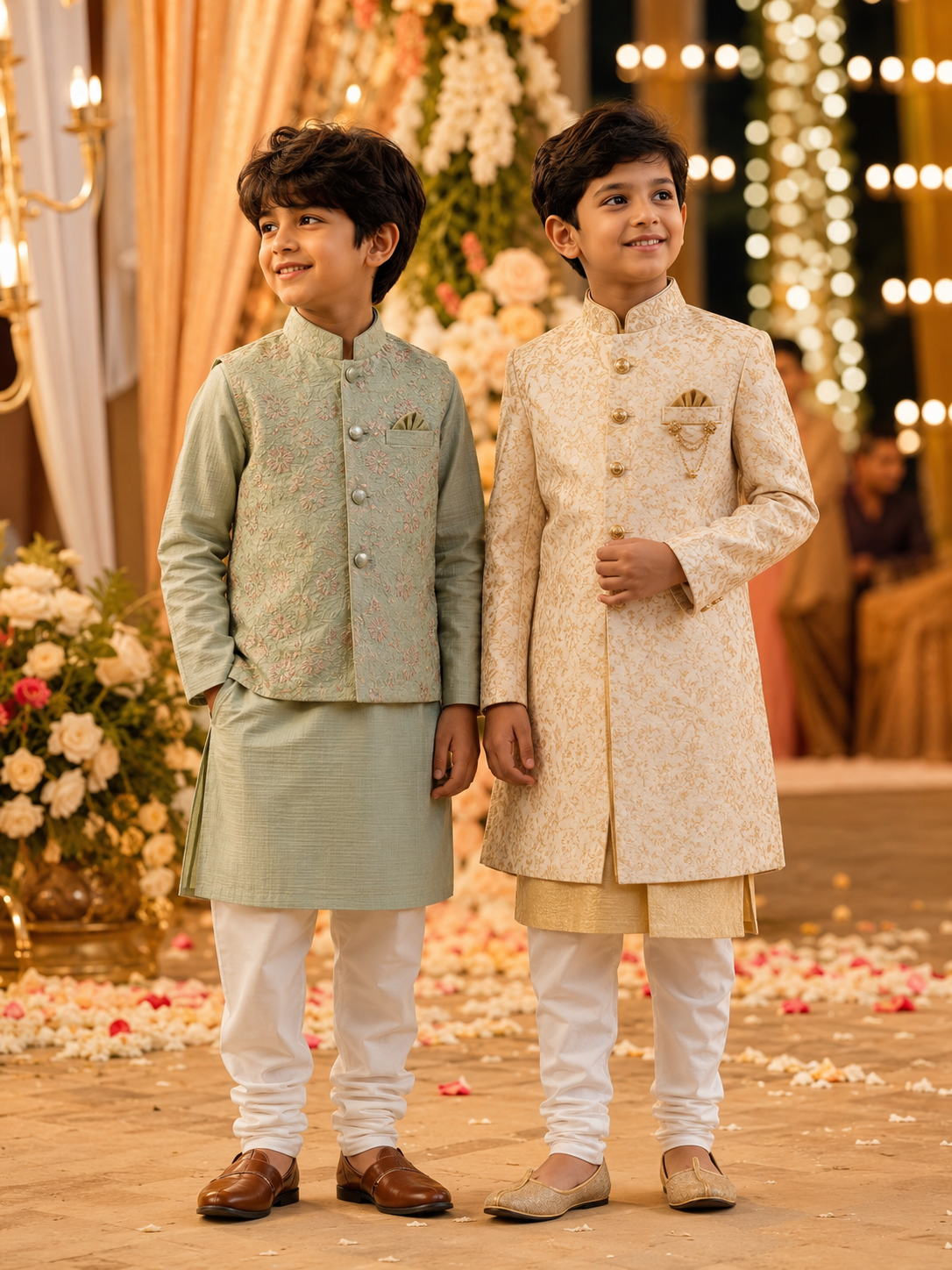
7 Myths About Boys’ Ethnic Wear: How to Choose the Right Outfit for Weddings & Festivals
Shopping for boys’ ethnic wear can look straightforward: choose a festive color, pick a traditional silhouette, and size up so there is room to grow. In practice, those shortcuts can lead to outfits that feel heavy, restrict movement, look oversized, or simply do not suit the event.
The best boys’ wedding or festival outfit is not necessarily the most embellished one. Comfort, proportion, fabric, event formality and how long the child will wear the outfit matter just as much as appearance. This guide breaks down seven common myths so you can make a more practical choice.

Myth 1: Boys’ ethnic wear has to be heavy to look festive
The truth: Festive style comes from the overall finish—not simply from weight or heavy embroidery. A well-cut kurta set in a refined fabric can look just as celebration-ready as a heavily embellished outfit, while being easier for a child to wear for several hours.
For daytime functions, pujas, family gatherings and festivals, lighter fabrics and simpler layers often make more sense. Look for clean tailoring, subtle woven texture, tasteful embroidery or a coordinated jacket rather than assuming more decoration always means a better outfit.

Myth 2: A sherwani is the best choice for every wedding event
The truth: A sherwani is a strong formal option, but not every wedding function requires the same level of dressing.
For a formal wedding ceremony or reception—especially for close family—a structured boys’ sherwani and churidar can feel appropriate. For mehndi, daytime celebrations or less formal gatherings, a kurta set or Nehru-jacket combination may be easier to move in and better matched to the mood.

Myth 3: A Nehru jacket automatically makes an outfit too formal
The truth: Nehru jackets can be one of the most versatile pieces in a boy’s festive wardrobe. Formality depends on the fabric, pattern, color and what the jacket is paired with.
A bright printed jacket over a simple kurta can work beautifully for Diwali, a mehndi event or a family celebration. A subtler woven or embroidered jacket can move the same basic outfit toward a wedding-ready look. This versatility is why boys’ Bandhgalas and Nehru jackets are useful when you want one layer that can transform a simple base outfit.

Myth 4: Buying one size bigger is always the safest choice
The truth: Some growing room is useful, but an outfit that is too large can look untidy and may be uncomfortable. Oversized shoulders, very long sleeves or excess fabric around the legs can also make active children less confident moving around.
Instead of sizing up automatically, compare the garment measurements with the child’s current measurements. Prioritize the shoulders and chest first, then check sleeve length, kurta or jacket length and the bottom fit. If the child falls between two sizes, choose based on the garment’s cut and the amount of ease already built into it.

Quick fit check before you buy
- Shoulders: seams should sit close to the natural shoulder line.
- Chest: there should be enough room to sit, eat and move comfortably.
- Sleeves: avoid excessive bunching at the wrist.
- Kurta or jacket length: check proportions, not just age-based sizing.
- Bottoms: the waistband should feel secure without digging in.
- Movement: the child should be able to walk, sit and raise the arms comfortably.
Myth 5: Silk-look and occasion fabrics are always uncomfortable for children
The truth: Comfort depends on more than the outer appearance of the fabric. Lining, fabric blend, garment construction, seams and the number of layers all affect how an outfit feels.
For long events or warm venues, consider breathable base layers and avoid unnecessary bulk. Check whether embellished areas touch the skin, whether the collar feels stiff, and whether a jacket can be removed later in the event. The goal is to keep the festive finish without forcing a child to spend the celebration adjusting the outfit.
Myth 6: Traditional footwear has to match the outfit exactly
The truth: Coordinating works better than exact matching. Neutral gold, tan, brown, cream or complementary tones can connect the outfit without making every piece look identical.
Comfort should come first, especially when the child will be standing, dancing or walking for hours. Traditional juttis or mojaris can finish a formal ethnic look, while a clean loafer can also work with certain Indo-western or Jodhpuri outfits. If footwear is new, let the child wear it briefly before the event instead of testing it for the first time on the day.

Myth 7: One ethnic outfit works equally well for every occasion
The truth: The same basic outfit can be styled in different ways, but event formality still matters. Instead of expecting one heavily formal look to cover everything, start with a comfortable base and adjust the layers.
A kurta-pyjama can work alone for a puja, gain a colorful Nehru jacket for a festival or mehndi, and become more formal with a structured layer and dressier footwear. For the most formal events, a sherwani or one of the boys’ Jodhpuri suits can create a sharper occasion look.
What should a boy wear to each wedding or festival event?
| Occasion | Good starting point | What to prioritize |
|---|---|---|
| Festival or puja | Kurta-pyjama or simple kurta set | Breathability, easy movement, lighter layers |
| Mehndi or daytime wedding event | Kurta + printed Nehru jacket | Color, comfort and playful festive details |
| Sangeet | Kurta set, jacket set or light Jodhpuri | Freedom to dance and move |
| Wedding ceremony | Sherwani, jacket set or formal kurta ensemble | Fit, structure and occasion formality |
| Reception | Sherwani or Jodhpuri suit | Polished tailoring and comfortable formal footwear |
A simple way to choose the right boys’ ethnic outfit
- Start with the occasion. Decide how formal the event actually is before choosing the outfit.
- Think about wear time. A two-hour ceremony and an all-day wedding require different comfort levels.
- Measure before ordering. Do not rely only on age labels.
- Check mobility. Children should be able to sit, walk and play naturally.
- Use layers strategically. A removable jacket gives more flexibility than a heavy outfit that cannot be adjusted.
- Coordinate accessories rather than overmatching. Let one or two elements make the statement.
Build the outfit around comfort, not myths
Boys’ ethnic wear does not need to be heavy, oversized or extremely formal to look special. The strongest outfit is the one that fits the event, fits the child properly and still lets him enjoy the celebration.
For more options, browse the full Boys Clothing collection, then narrow the look by occasion—whether you need a comfortable festive kurta, a versatile Nehru jacket, a formal sherwani or a structured Jodhpuri suit.

Leave a comment
This site is protected by hCaptcha and the hCaptcha Privacy Policy and Terms of Service apply.